Who signed the Math and AI declaration?
Countries of the endorsers compared with where mathematics is published. Snapshot of 4 November 2026.
Key findings
- 8,429 people had endorsed the declaration A Severe Misalignment of AI in Mathematics on 4 November 2026. For 6,841 of them the stated affiliation identifies a country.
- Endorsers come overwhelmingly from Western Europe and North America. Ten countries with a Concern Index of 1.5 or more (the United States, the large Western European countries, Switzerland, Austria, the Netherlands and Portugal) write 25% of the world's mathematics papers but supply 68% of endorsers.
- Sixteen countries where endorsers are nearly absent (Concern Index below 0.2), led by China, Saudi Arabia, Russia, Türkiye and Iran, write 42% of the world's mathematics papers but supply 5% of endorsers. China alone takes part in 35% of 2025 mathematics papers and supplies 3.4% of endorsers.
- The 1,283 people who signed after 16 September did not change this split. The share from the nearly-absent group fell further, from 5.6% to 3.6%.
The declaration and the two data sources
The declaration A Severe Misalignment of AI in Mathematics (mathandai.org, doi:10.5281/zenodo.22737750) was published on 11 September 2026. It argues that AI companies' use of mathematical problems as benchmarks conflicts with what mathematics is for: understanding, proper attribution, and passing ideas from person to person. It calls on mathematicians, AI companies and society to respond. It is published in eight languages, including Chinese, Japanese and Russian. The public endorser list shows each person's name and, if given, a free-text affiliation.
Endorsers. We downloaded the complete public list on 4 November 2026 (8,429 endorsers). 6,924 of them (82%) gave an affiliation. These free-text affiliations were matched to the Research Organization Registry (ROR), an open registry of research organisations that records each organisation's country. Matching was automatic first, then reviewed by hand (see How the countries were assigned below). In the end, 6,841 endorsers have at least one country. A person counts once in each country where they list an organisation, so the 42 endorsers with organisations in two or three countries count in each of them.
Mathematics papers. As a yardstick for how much mathematics each country produces, we use Scopus, a large commercial citation database. We counted the 212,175 articles and reviews from 2025 in its Mathematics subject area (exported 15 September 2026) and took each country's share of them. A paper counts for every country among its authors' addresses, so China's 35% means that 35% of the papers have at least one author with a Chinese address.
The Concern Index
For each country, the Concern Index is
share of endorsers with that country ÷ share of world 2025 mathematics papers with that country.
A value of 1 means a country supplies endorsers in proportion to its mathematical output. A value of 2 means twice its share of papers, and 0.1 means a tenth. The index measures who has put their name to this particular declaration. It does not measure what mathematicians in a country think about AI (see Caveats below).
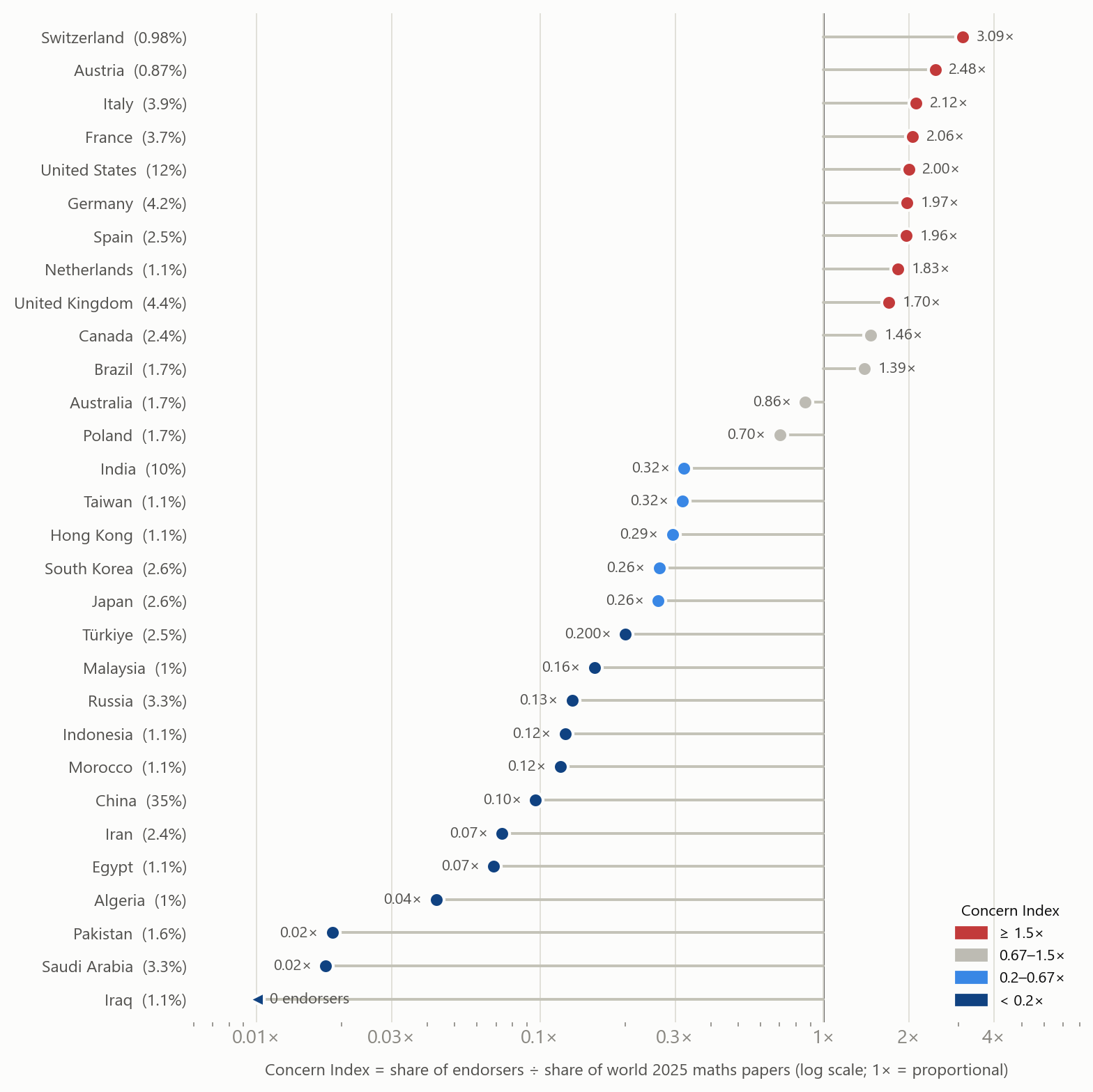
Figure 1. Concern Index for the 30 countries with the most 2025 Scopus mathematics papers. Each country's share of world papers is shown in brackets after its name. Logarithmic scale. Colours mark the four groups used in Figure 2.
| Country | Share of 2025 maths papers | Share of endorsers | Concern Index |
|---|---|---|---|
| China | 35.3% | 3.4% | 0.10 |
| United States | 12.2% | 24.3% | 2.00 |
| India | 10.1% | 3.3% | 0.32 |
| United Kingdom | 4.4% | 7.5% | 1.70 |
| Germany | 4.2% | 8.2% | 1.97 |
| Italy | 3.9% | 8.2% | 2.12 |
| France | 3.7% | 7.6% | 2.06 |
| Saudi Arabia | 3.3% | 0.06% | 0.02 |
| Russia | 3.3% | 0.4% | 0.13 |
| Japan | 2.6% | 0.7% | 0.26 |
Table 1. The ten largest producers of 2025 mathematics papers. The complete table for all 159 countries is in data/country_table.csv.
Switzerland (3.1), Austria (2.5), Italy, France, the United States, Germany and Spain (each about 2) have the highest values among countries with at least about 1% of world papers. Canada, Brazil, Australia, Poland and the Nordic countries (Sweden 1.44, Denmark 1.41, Finland 1.06, Norway 0.85) are close to proportional. All large Asian producers are well below 1: India 0.32, Japan and South Korea 0.26, China 0.10. Countries in the Middle East and North Africa are lowest of all: Iran 0.07, Saudi Arabia and Pakistan 0.02, and Iraq, with 1.1% of world papers, has no endorser at all.
The country split
The Concern Index matters for the declaration's aims because of how papers and endorsers are spread across countries. To see this, we put the 50 countries with at least 1,000 papers in 2025 into four groups by their Concern Index and compare each group's share of world mathematics papers with its share of endorsers (Figure 2). The other 108 countries are shown as small producers. In this comparison, every country an author is counted for adds to that country's group, and the group shares are scaled so that each bar adds up to 100%.
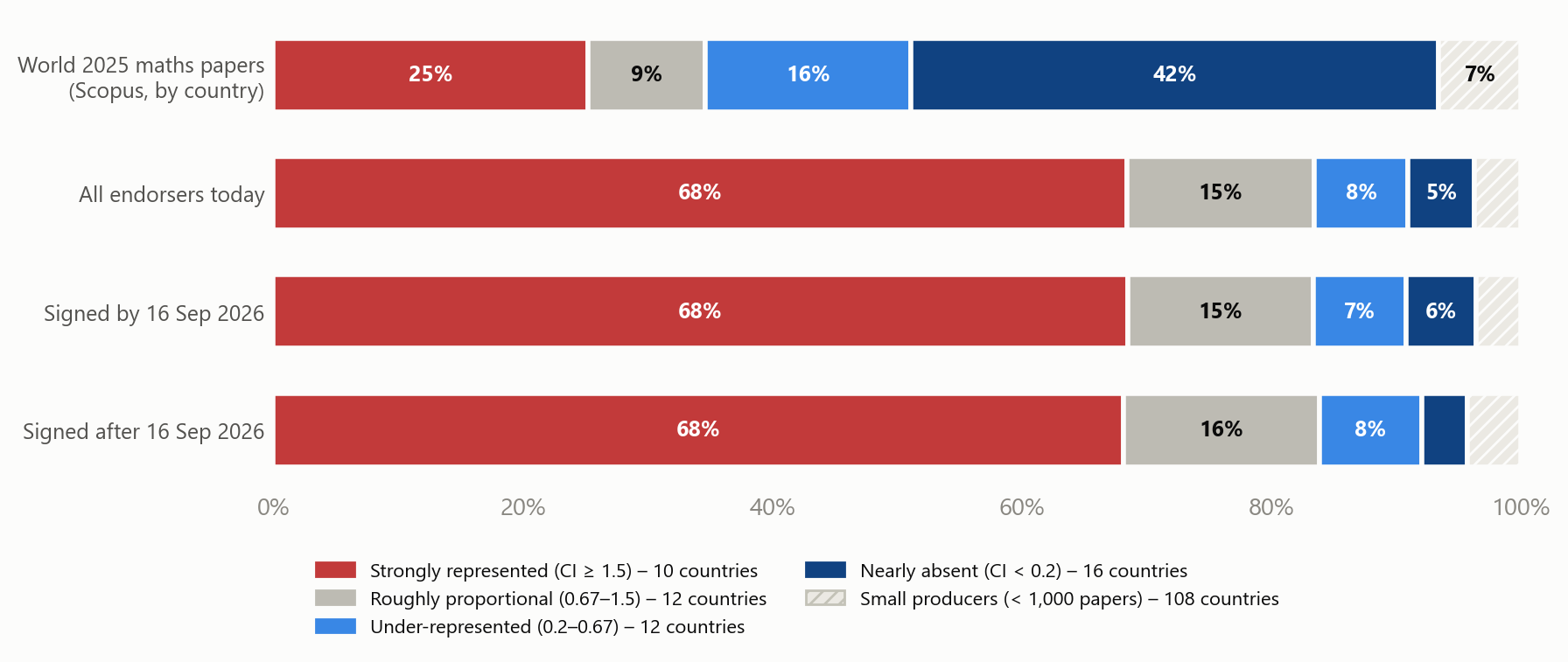
Figure 2. Each bar is split by Concern Index group. Top bar: shares of 2025 mathematics papers. Lower bars: shares of endorsers, all together and separately for those who signed by 16 September 2026 and after it. Group members: ≥ 1.5 — US, GB, DE, IT, FR, ES, NL, CH, AT, PT; 0.67–1.5 — CA, AU, BR, PL, MX, SE, BE, CZ, GR, CL, NO, DK; 0.2–0.67 — IN, JP, KR, HK, TW, VN, UA, RO, ZA, IL, SG, HU; < 0.2 — CN, SA, RU, TR, IR, PK, IQ, MA, ID, EG, MY, DZ, TH, JO, AE, TN.
The split is lopsided:
- The strongly represented group (10 countries) writes 25% of the world's mathematics papers and supplies 68% of endorsers.
- The nearly absent group (16 countries) writes 42% of the papers and supplies 5% of endorsers. China alone writes 26% of the papers by this scaled measure and supplies 3.4% of endorsers.
- China and India together write a third of the papers (33%) and supply 7% of endorsers.
The declaration asks the mathematical community, among others, to respond to how AI is being used in mathematics. Any practice it hopes to change will reach most of the world's mathematics papers only if it is also taken up in the countries in the two blue groups. Together they write 59% of papers and supply 13% of endorsers. On the evidence of its endorser list, the declaration so far speaks mainly for the mathematical communities of Western Europe and North America. These communities write about a quarter of the world's mathematics papers.
Figure 3 shows the same data for each country. Countries above the diagonal supply more endorsers than their share of papers, and countries below it fewer. The dotted lines mark the group boundaries at 1.5, 0.67 and 0.2.
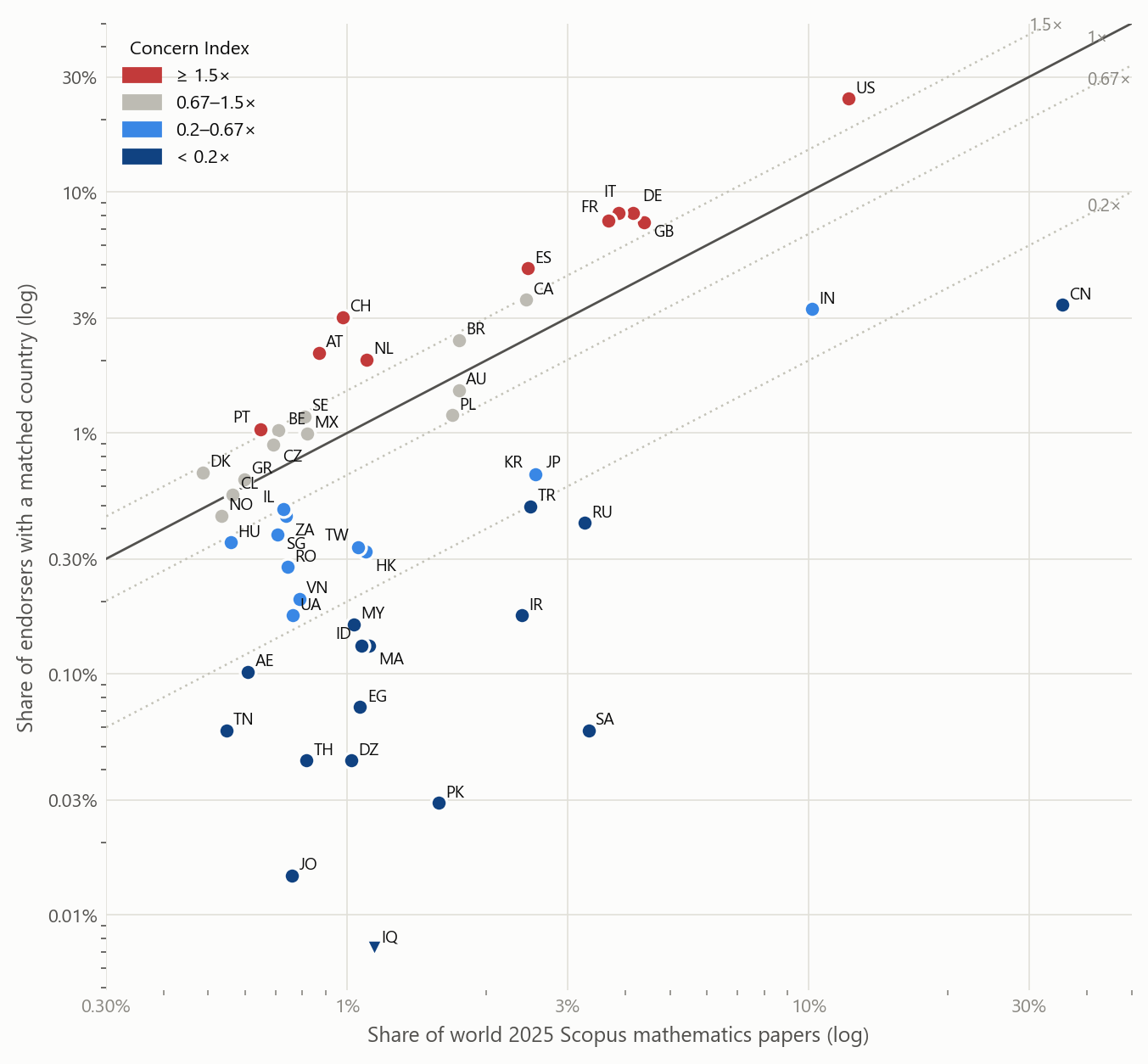
Figure 3. Share of endorsers (vertical) against share of world 2025 Scopus mathematics papers (horizontal) for the 50 largest producers. Both axes are logarithmic. Labels are two-letter country codes. Iraq has no endorser and is drawn at half of one endorser (▼) because zero cannot be shown on a logarithmic scale.
What changed since 16 September
On 16 September 2026 we analysed an earlier copy of the list (7,166 endorsers). Of those, 7,146 were still listed on 4 November; 20 had been removed. 1,283 people signed later. Both groups were matched in the same way, so the difference between them reflects who signed, not a change of method.
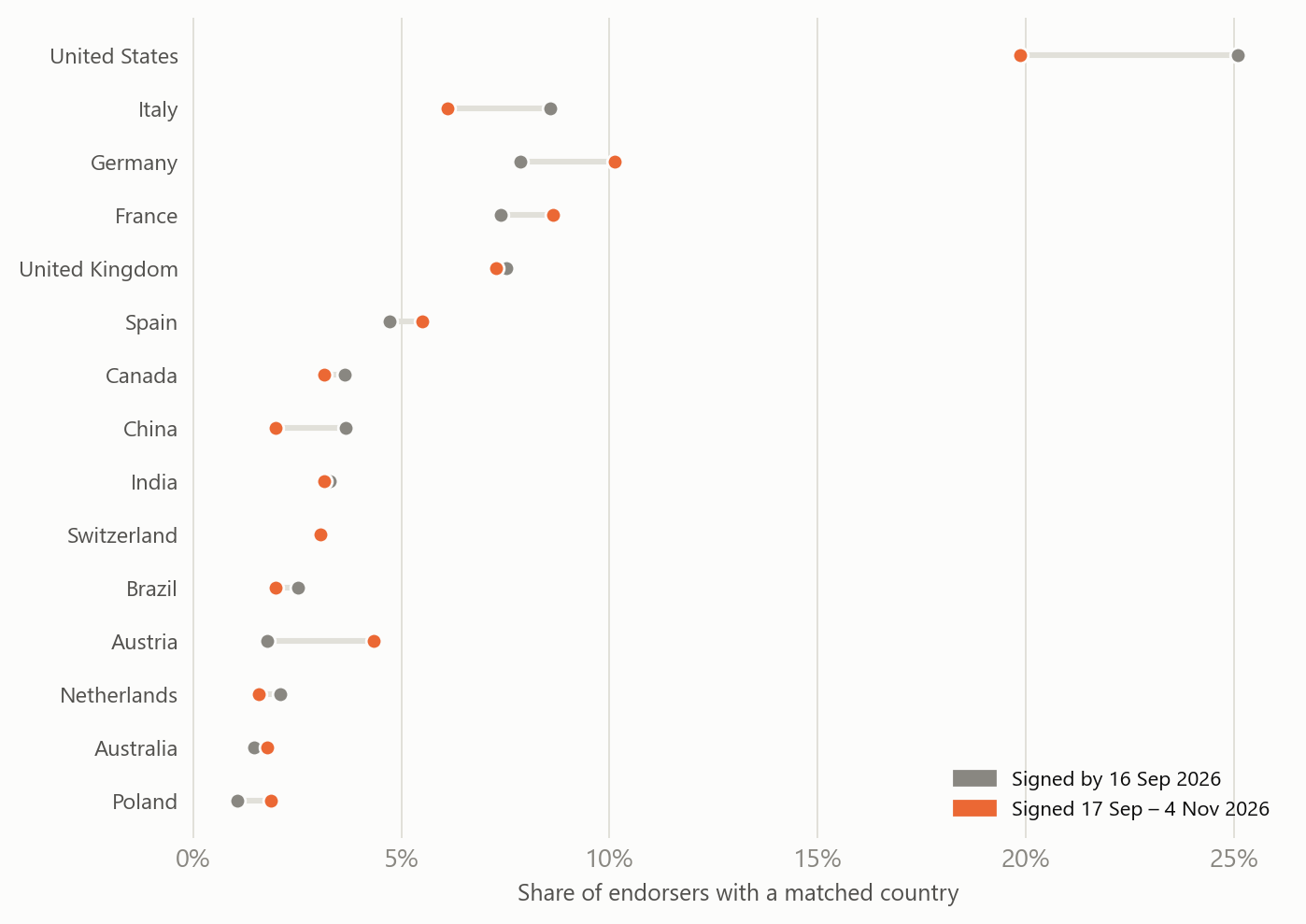
Figure 4. Share of endorsers among those who signed by 16 September (grey) and later (orange), for the 15 countries with the most endorsers.
- Among later signers, the United States share fell from 25% to 20%. Germany (7.9% → 10.1%), France (7.4% → 8.7%), Austria (1.8% → 4.3%), Spain and Portugal rose. Italy fell (8.6% → 6.1%).
- China's share fell from 3.7% to 2.0%. Iran, Pakistan, Malaysia and Algeria had no new endorser.
- The split did not move. The strongly represented group supplies 68% of endorsers in both groups of signers. The nearly-absent group fell from 5.6% to 3.6%. The second wave of signatures came mostly from continental Europe and did not widen the declaration's base beyond it.
The Concern Index values reported in September (based on 5,727 matched endorsers) are close to today's: United States 2.08 then and 2.00 now, Italy 2.19 and 2.12, China 0.10 and 0.10, India 0.31 and 0.32. Austria rose the most, from 2.09 to 2.48.
How the countries were assigned
The 2,953 distinct affiliation texts were first matched automatically against ROR (version 2.15 of 20 October 2026, with English names from Wikidata). This placed 94.9% of endorsers who gave an affiliation. Every difficult case was then decided by Opus 5.5. high, where in September a weaker local language model had done this: every unmatched text, every match made by a weaker rule (acronyms, ties between namesakes), every text naming several organisations, and every text that was new or had changed country since September. That came to 1,477 texts (2,978 endorsers). For about 20 ambiguous cases the endorser's public ORCID record was checked. The review changed the country of 348 endorsers. Typical errors it removed: "Ecole Normale Supérieure" matched to a school of that name in Burundi, "USC, RSME" matched to an Australian university instead of Santiago de Compostela, and "Oxford & MPI" losing one of its two countries. Whole counting and fractional counting (an endorser with two countries counts half in each) give practically the same Concern Index, with a largest difference of 0.04, so whole counting is used as in September.
Caveats
- Endorsing is not the same as being concerned. A low Concern Index means few endorsers from that country. It does not mean that mathematicians there are unconcerned about AI. How far the declaration spread through personal and professional networks, which are densest in Europe and North America, probably matters a great deal. So may language, though the text is translated, and in some countries how safe it is to sign a public statement originating from US\EU.
- Papers are not people. Scopus Mathematics also includes many applied, engineering and interdisciplinary journals, and the number of papers per researcher differs between countries. This probably makes China, India and some Gulf states look larger as producers of research mathematics than they are. A count of mathematicians, or a narrower set of core mathematics journals, would lower their paper shares and raise their Concern Index values. It would be unlikely to change the overall split, because the gaps are tenfold or more.
- Affiliation is not nationality. Country means the country where the organisation an endorser names is registered, not where the person comes from. 1,505 endorsers (18%) gave no affiliation and could not be placed. If they differ by country from those who did, the shares shift.
- Snapshots. The endorser list is live, and Scopus counts change as more papers are indexed. The figures describe 4 November 2026 (endorsers) and 15 September 2026 (Scopus).
Data and code: the country table (country_table.csv), the group table (country_split.csv) and the run summary are in data/ next to this page. Endorser-level data, which contain names, are not published here. The procedure, commands, decision files and checksums are documented in mathandai/README.md of the matching repository.