WikiViews: how the world reads about its universities on Wikipedia
Live site: wikiviews.uniquation.org · Full report: UniQuation WikiViews report (PDF, 50 pages)
WikiViews is an open, interactive explorer of Wikipedia readership for higher education institutions worldwide. For every active educational institution in the Research Organization Registry (ROR) it finds the institution's Wikipedia articles in 31 language editions and counts how many times people read them, month by month, from January 2020 to February 2026.
Wikipedia is one of the most visited websites in the world and, for many people, the first place they look up a university. Its pageviews are therefore a large-scale, openly available signal of public attention to universities: a complement to bibliometric indicators, which capture scholarly communication, and to rankings, which mix many inputs behind a single number. WikiViews makes that signal measurable, comparable and transparent.
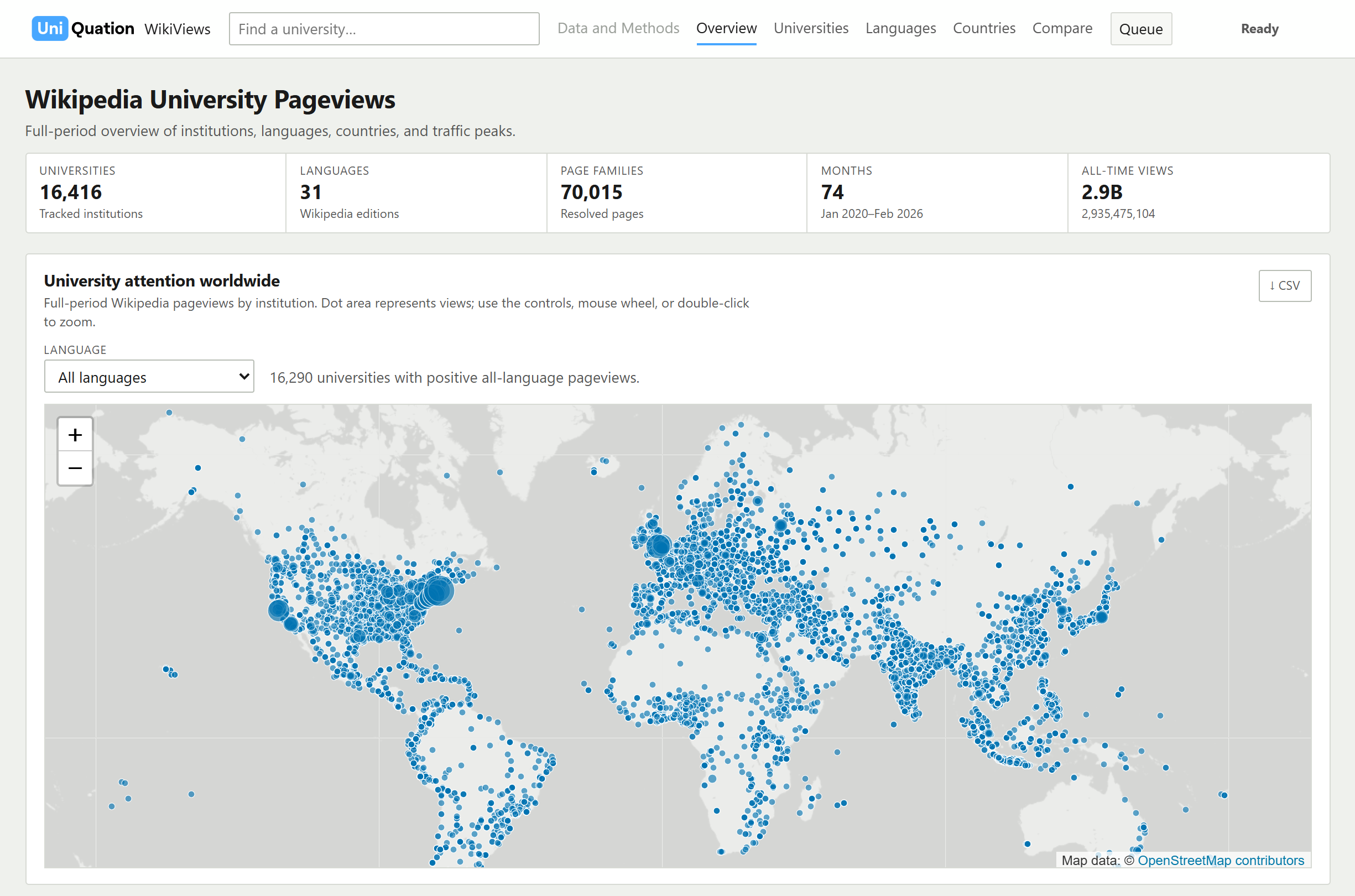
The overview page. Every dot is an institution; its area shows full-period Wikipedia pageviews. The map can be filtered to any of the 31 language editions.
At a glance
| 2.9 billion | human pageviews of university articles analysed |
| ≈ 40 million | pageviews in an average month |
| 16,416 | institutions tracked, in 218 countries and territories |
| 31 | Wikipedia language editions, from English and Chinese to Bengali and Vietnamese |
| 70,015 | Wikipedia articles, each counted together with all its redirects |
| 74 months | of continuous monthly data, January 2020 – February 2026 |
| 16,413 | institutions linked to their 2021–2025 research output in OpenAlex |
The most-read universities over the period are Harvard (30.9 million views), Oxford (18.4 million), Stanford and MIT (16.1 million each). Beyond English, which accounts for about 1.7 billion views, Japanese, Chinese, Russian and Spanish Wikipedia each bring more than 100 million views of university articles, and attention reaches institutions on every continent.
How it works
The pipeline is built entirely from linked open data:
- Institutions come from ROR (release v2.5): all records classified as active and education, which covers universities, colleges, arts academies and similar institutions.
- Articles are found by following each institution's Wikidata identifier to its Wikipedia articles in 31 languages. Every article is resolved to its canonical page, and every redirect pointing to it (such as "Caltech" for the California Institute of Technology) is recorded, so no traffic is lost to alternative titles.
- Pageviews come from Wikimedia's monthly pageview-complete dumps, restricted to the "user" agent type, which excludes traffic Wikimedia classifies as crawlers or automated. Desktop, mobile web and app views are summed. When several ROR records point to the same article, the views are assigned to a single institution by a documented rule, so nothing is counted twice.
- Research context comes from OpenAlex: publication counts for 2021–2025 and each institution's profile across 26 research fields.
All corrections to the source data are documented on the site's Data and Methods page and in the full report.
What you can do with it
- Explore rankings of universities, languages and countries, with filters by language edition, country, city and period, and download every table as CSV.
- Profile a university: monthly trends, its readership across languages, the length of its Wikipedia articles relative to the median in each language, its research profile, a map of nearby institutions, and its ROR record.
- Benchmark against peers: WikiViews proposes five comparable institutions using four transparent criteria (pageview scale, language profile, research output and subject focus), and the user can re-weight, replace or add peers.
- Compare up to ten universities side by side on one board.
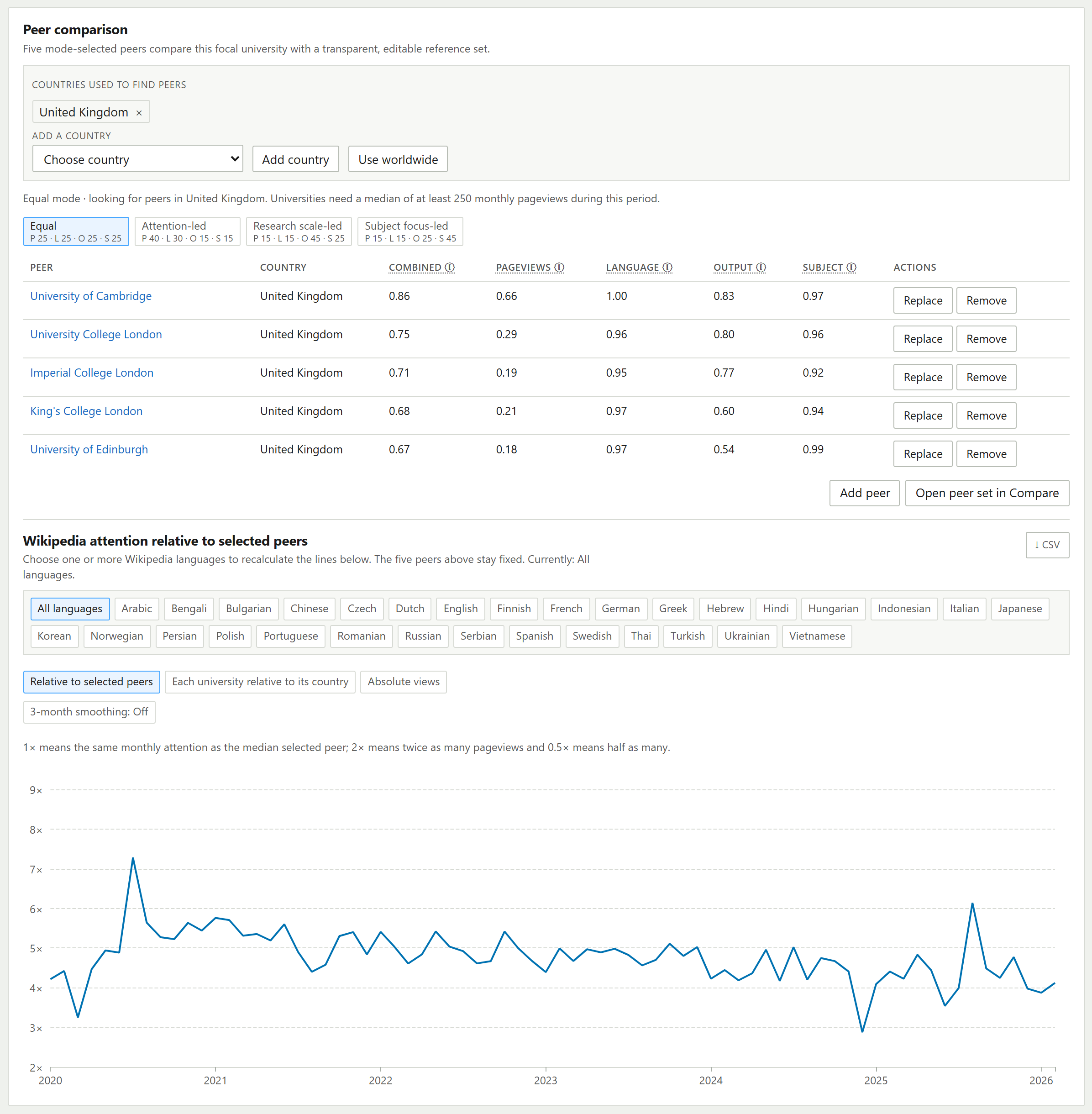
Peer benchmarking on the University of Oxford's profile. Peers are chosen by a weighted, fully visible similarity score; the chart shows Oxford's monthly Wikipedia attention as a multiple of the median selected peer (here around four to five times), and can be recalculated for any combination of languages.
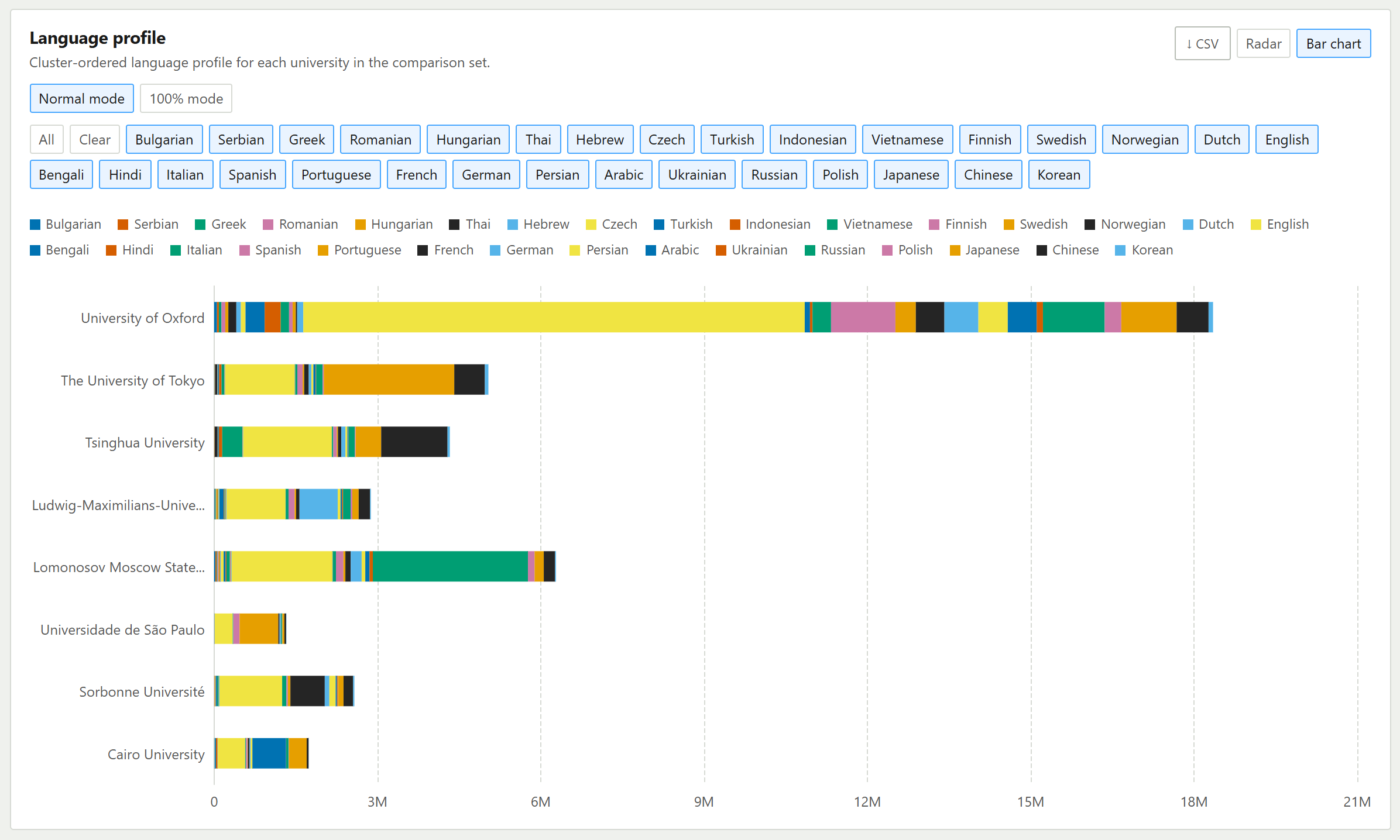
The comparison board: how the Wikipedia readership of eight universities is spread across language editions. Tokyo, Lomonosov Moscow State, São Paulo and Cairo are read most in their national language (Japanese, Russian, Portuguese and Arabic Wikipedia), while Tsinghua, LMU Munich and Sorbonne already draw more readers in English than in Chinese, German or French. Each colour is one language edition.
Credits
Methodology, data collection and processing, and the analytics interface: Ivan Sterligov, with additional input from Elena Zhebrak. Project coordination: Egor Yablokov. Developed by UniQuation and E-Quadrat Science & Education, 2026. Based on public data from Wikimedia, Wikidata, ROR and OpenAlex. The site uses no cookies or tracking.